
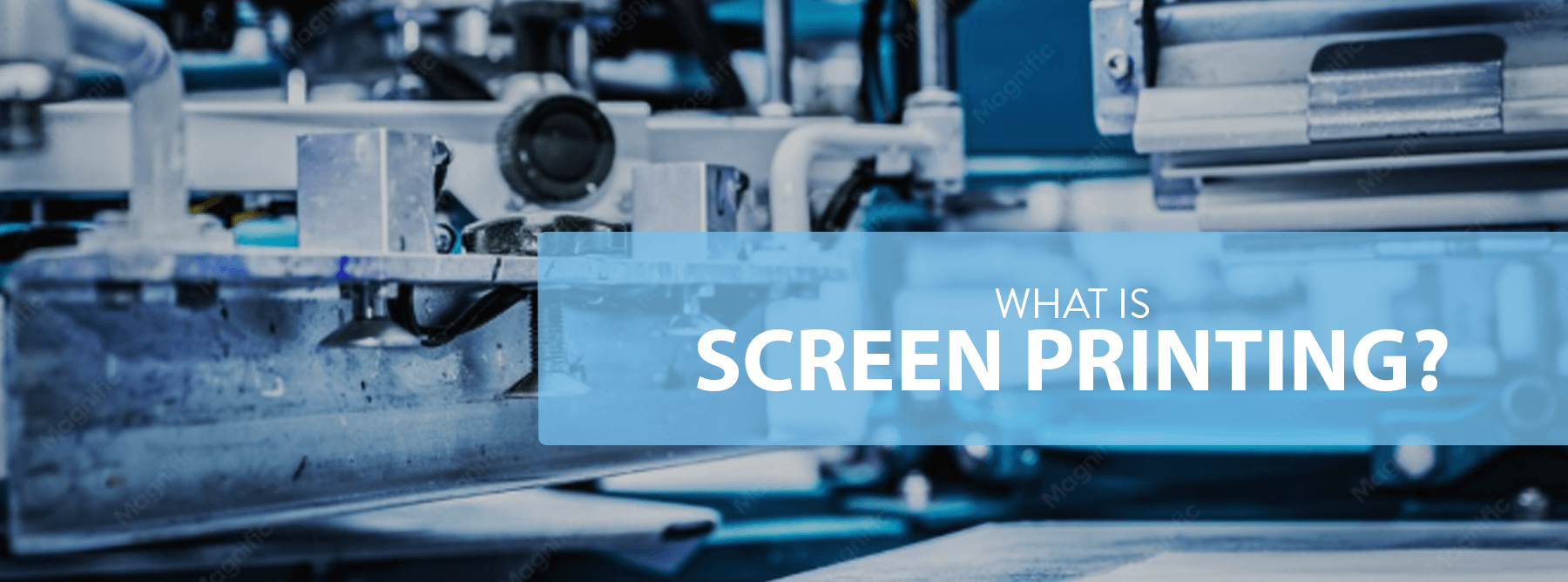
WHAT IS SCREEN PRINTING?
Screen printing is an efficient, high-quality method for applying complex designs to surfaces with ink. It’s most commonly associated with printing on fabrics, especially T-shirts, hoodies, bags, and other clothing, but the technique can also work on other materials.
In this article, we’ll run through the basics of screen printing, then go into more detail about the techniques used to take a design from a screen or paper to a finished product.
THE BASIC PRINCIPLE OF SCREEN PRINTING
We are all familiar with the concept of a stencil. It’s where a design is cut out of a piece of card or thin plastic, and when it’s painted over, only the spaces where the gaps exist get coloured. It’s a quick way to get a design onto a surface, which is perfect when you’re someone like Banksy and need to be in and out as soon as possible before being caught or, more importantly, identified. But another benefit of stencilling is that the same template can be used over and over again. All the hard work goes into designing and cutting out the image – applying paint to the surface takes seconds. However, stencilling does have one drawback. Because the shape needs to be held rigidly in place, you need supporting sections to remain uncut in the stencil sheet. If there are floating parts (such as the middle of the letters O, P, A or R) there needs to be something holding the island in place. The familiar “military”- style typefaces are a good example of this. It’s a case where substance takes precedence over style, so when you need to paint IDs on thousands of tanks, the stencil lets you do each one with a few brushstrokes or a few squirts from a spray can. The downside is that you’ll be left with incomplete lettering.
Screen printing takes the concept of stencilling and refines it, allowing intricate, complex, and detailed images to be printed onto surfaces. It achieves this by having the reverse image float on a fine criss-cross mesh. The individual strands of the mesh hold the whole image, with all its various pieces, in place, but because the strands are so fine, they don’t create visible gaps – the liquid ink or paint just fills the whole area, leaving blank the areas where the design is captured. Where the design has multiple colours, each colour needs its own screen, and the ink needs to dry between each one. If the design is made of large blocks of colour (e.g., the red and blue of the Domino's logo), then each colour can be printed separately using inks of the corresponding colour. If the image is more complex and graded (e.g. a colour photo or the Instagram logo), then the image needs to be separated into individual cyan, magenta and yellow images, with black and/or white, and the images are precisely positioned so that any colour can be achieved, just like a photograph or inkjet printer.
THE PROCESS OF SCREEN PRINTING
Screen printing has two distinct steps to get from a design to a finished product. The first is creating the screen itself from the image, and the second is printing the image onto the fabric. Let’s go through them in detail. If you start with a single-colour image, the process is pretty straightforward. The image is digitised and printed onto a sheet of acetate. Then the screen is coated with a light-reactive emulsion, and UV light is shone through it, just like taking a photograph on film or printing one in a darkroom. The area that remains dark does not react, whereas the exposed area reacts chemically. It is then chemically processed, just like a photograph, and after the waste is washed away, you are left with a negative image on the screen.
For multi-colour images, a separate screen needs to be made for each colour. For large coloured blocks, that can mean, say, a purple block, a pink block and a green block, and those exact colours can be printed. However, for more complex images with many colours that blend into each other, the only way is to digitally split the image into primary colours plus black and/or white. Just as your computer monitor can make any colour from millions of red, green and blue lights, a separated screen print can make any colour by blending the primary colours, although for technical reasons it’s more likely to be cyan, magenta, yellow and black/white. The individual screens are then left to dry. After that, the screens are hand-finished to ensure no leakage occurs.
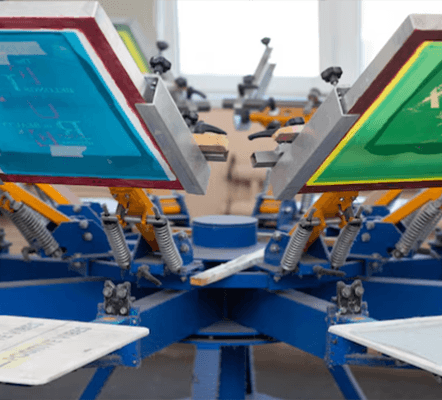
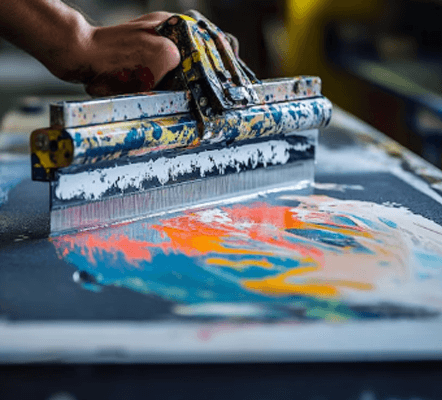
Next, the screen stencils are used to make the prints. On a small scale, this can be done by hand by pressing the screen against the fabric, squirting some ink along one end, then dragging a squeegee along it to spread the ink across the image and force it through the gaps in the stencil. For industrial applications, multiple items (e.g. T-shirts) are put on a machine, and it carries out this process mechanically. The individual colours need to be allowed to dry between prints, but techniques such as heating and chemical curing can speed up the process and make the image washable and permanent. For multi-colour prints, the screens need to be aligned with incredible precision so the image doesn’t look blurry or disjointed.
THE BENEFITS OF SCREEN PRINTING
Screen printing comes with a number of benefits over other forms of customisation, which we’ll cover here.
Any design can be printed
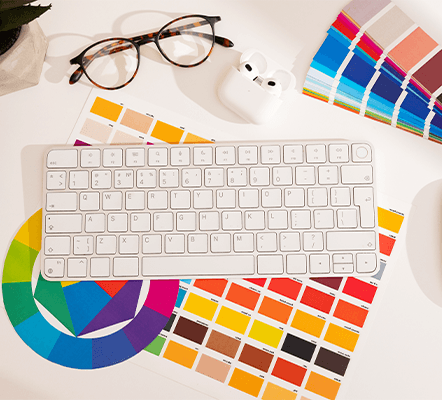
A key benefit is that pretty much any design can be printed using screen printing, because an image is made up of “pixels” of colour. The only limiting factor is that dots cannot be smaller than the size of a hole in the mesh, for obvious reasons. However, for the most common purpose – printing on fabrics and clothing – the smallest possible dot size is sufficient for any application, because the fabric itself is made of a criss-cross of threads, which are wider than the mesh.
Repeat printing and cheap large runs
The same screen stencil can be used many times, as long as it is cleaned thoroughly and stored properly between uses. Much of the cost of screen printing is in preparing the screens themselves, so once that is covered, the only costs are materials and labour.
quick and less waste
With screen printing, there is hardly any wasted ink because the squeegee either forces it through the mesh or pushes it to the end, where it can be used on the next print. Combined with the reusable screens, it results in an efficient task. Particularly with digital assistance, complex, multi-colour images can be processed from a digital file to screens quickly, so jobs can be turned around quickly.

it's widely used
Screen printing is used all over the world by thousands of printers, so there’s a whole ecosystem of manufacturers of machinery, consumables and other equipment. That all helps to keep costs down but also ensures the whole range of products is always available.
drawbacks of screen printing for t-shirts
There are some minor drawbacks of screen printing that sometimes make other methods more appropriate for a given task.
Costs for small runs
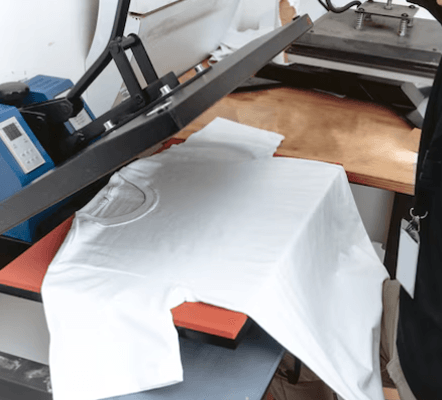
If you need a one-off print, screen printing probably isn’t the optimal way to do it, at least from a cost perspective. That’s because the preparation of the screen itself represents a large chunk of the price, so there’s no economy of scale. DTG (direct-to-garment) should be lower-cost for a single print or a short run.
Pinpoint precision
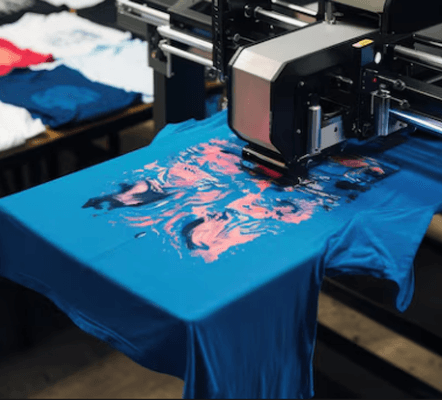
The limitations of precision ultimately come down to the mesh gauge, as mentioned above. Images intended to be viewed very closely or with very small text would not be precise enough for screen printing.
Slower than some methods
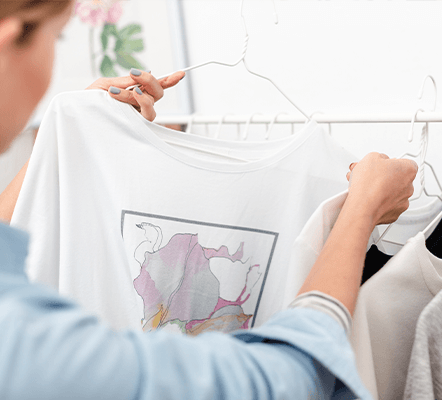
Although it’s quick to turn around a planned job, if you want your printed items today or tomorrow, screen printing probably isn’t the method for you, because of the prep time. Again, DTG printing will get the job done almost instantly, but at a cost.
Can be less permanent than other methods
Although a well-made screen-printed T-shirt will still look great after dozens of washes and plenty of wear, the inks will eventually start to fade. If permanence is important, the gold standard is embroidery, where fast-dyed threads are used to create images that will never really fade. Embroidery does come with its own limitations, however, such as photorealism or colour blending.
professional screen printing in the uk
Screen printing can be done in a kitchen as a hobby, but if you want large runs with multiple colours and precise colour matching, it’s best to hire a professional printer. That’s where Screen Textiles comes in. We have the most up-to-date equipment, access to professional inks and other materials, and the know-how to take on screen printing jobs of any size.
If you’re looking for a professional finish on your T-shirts, hoodies, bags, or other print jobs and want to keep costs to a minimum, we can work together.